Droven io Future Technology USA: How Connected Intelligence Is Shaping the Next Digital Era

Introduction
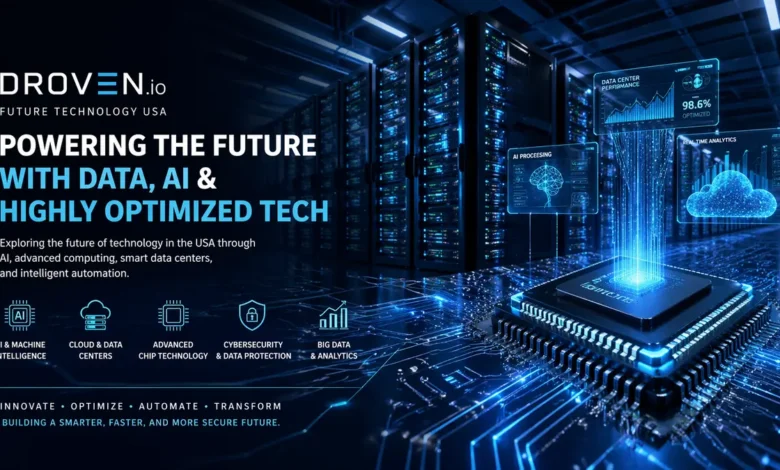
The idea behind droven io future technology usa represents a broader vision of how technology is evolving in the United States. It is not about a single product or app, but about a connected ecosystem where artificial intelligence, smart devices, and data networks work together in real time.
In simple terms, this concept reflects a future where machines, cities, vehicles, and digital systems communicate seamlessly. Instead of operating independently, everything becomes part of one intelligent network that can observe, learn, and respond instantly.
To understand why this matters, we need to explore how this type of system works, what technologies support it, and how it could transform everyday life in the USA.
Understanding Droven io Future Technology USA
At its foundation, droven io future technology usa can be seen as a model of a highly connected digital environment. It combines automation, data sharing, and artificial intelligence into a single coordinated system.
Rather than thinking of technology as separate tools—like phones, cars, or software—it imagines a world where all these tools are part of one shared intelligence layer.
For example:
- A car communicates with traffic systems in real time
- A hospital system predicts patient needs before emergencies happen
- A city adjusts electricity usage based on demand instantly
This type of integration is what defines the idea behind droven io future technology usa.
The Core Vision: A Living Digital Network
To understand this better, imagine a nervous system for an entire country.
In the human body:
- The brain processes information
- Nerves send signals
- The body reacts instantly
In droven io future technology usa:
- AI acts as the brain
- IoT devices act as sensors
- Infrastructure acts as the body
Everything is connected, and everything responds dynamically.
Key Technologies Behind Droven io Future Technology USA
Several advanced technologies make this vision possible. Each one plays a specific role in building a fully connected system.
Artificial Intelligence (AI)
AI is the decision-making core of droven io future technology usa.
It helps systems:
- Analyze large volumes of data
- Detect patterns in real time
- Make automated decisions without human delay
For example, AI could adjust traffic flow in a busy city by analyzing congestion patterns every second.
In healthcare, it could identify early signs of illness before symptoms become severe.
AI is what turns raw data into meaningful action.
Internet of Things (IoT)
IoT is the “sensing layer” of this system.
It includes everyday devices connected to the internet, such as:
- Smart traffic lights
- Environmental sensors
- Wearable health devices
- Connected vehicles
These devices constantly collect data from the physical world and send it into the digital system.
Without IoT, droven io future technology usa would not have real-world awareness.
Edge Computing
Speed is critical in real-time systems.
Edge computing allows data to be processed near where it is generated instead of sending everything to a central server.
This is important because:
- It reduces delays
- It improves real-time responses
- It supports critical systems like autonomous driving
For example, a self-driving car cannot wait for cloud processing—it must react instantly to avoid accidents.
Cloud Computing
While edge computing handles speed, cloud computing handles scale.
The cloud:
- Stores massive amounts of data
- Trains AI models
- Coordinates system-wide intelligence
In droven io future technology usa, the cloud acts as the long-term memory of the system.
Real-World Applications of Droven io Future Technology USA
The true impact of this concept becomes clear when applied to real industries.
Smart Cities in the USA
One of the biggest transformations would be in urban environments.
In smart cities powered by droven io future technology usa:
- Traffic lights adapt automatically to congestion
- Public transport schedules adjust dynamically
- Energy systems balance usage in real time
This creates cities that feel responsive rather than static.
A city would essentially “think” and adjust itself based on human activity.
Autonomous Transportation Systems
Transportation is one of the most important areas of change.
With droven io future technology usa:
- Cars communicate with each other to prevent collisions
- Highways adjust speed limits dynamically
- Delivery drones reroute based on weather conditions
This reduces accidents and improves efficiency across entire transport networks.
Instead of individual smart vehicles, the entire transportation system becomes intelligent.
Healthcare Transformation
Healthcare systems could become predictive rather than reactive.
Examples include:
- Wearable devices monitoring patient health continuously
- AI predicting medical risks early
- Hospitals automatically preparing for incoming emergencies
This shift means treatment begins before a condition becomes critical.
Logistics and Supply Chain Optimization
Global supply chains would become far more efficient.
In a droven io future technology usa environment:
- Warehouses track inventory in real time
- Delivery systems automatically adjust routes
- Supply chains predict disruptions before they happen
This reduces delays and waste while improving reliability.
Agriculture and Food Systems
Even farming would become highly data-driven.
Farmers could use:
- Soil sensors for precise irrigation
- Weather prediction systems for crop planning
- AI tools for yield optimization
This leads to more sustainable and efficient food production systems.
Benefits of Droven io Future Technology USA
The advantages of this type of system are wide-ranging and deeply impactful.
1. Real-Time Intelligence
Systems respond instantly to changes in environment and demand.
2. Higher Efficiency
Automation reduces wasted time, energy, and resources.
3. Improved Safety
Predictive systems help prevent accidents, failures, and emergencies.
4. Smarter Resource Management
Energy, transportation, and infrastructure are optimized automatically.
5. Better Decision-Making
AI systems process more data than humans ever could, leading to more accurate decisions.
Challenges and Limitations
While the potential is enormous, droven io future technology usa also brings important challenges.
Data Privacy Issues
With so many connected devices, vast amounts of personal and environmental data are collected.
This raises concerns about:
- Data ownership
- Surveillance risks
- Information misuse
Strong governance systems are required to protect users.
Cybersecurity Risks
More connections mean more vulnerabilities.
Possible threats include:
- System hacking
- Data manipulation
- Infrastructure attacks
Security must evolve alongside the technology.
High Implementation Costs
Building such advanced systems requires:
- Advanced infrastructure
- Skilled engineers
- Large-scale investment
This could slow adoption in some areas.
Over-Reliance on Automation
If systems become too dependent on automation:
- Human oversight may decrease
- System failures could have large-scale effects
- Critical thinking may be reduced in some areas
Balance between automation and human control is essential.
The Future of Droven io Future Technology USA
The United States is already moving toward many of the ideas represented by droven io future technology usa. AI systems, autonomous vehicles, and smart infrastructure are developing rapidly.
In the future, we may see:
- Entire cities operating as intelligent ecosystems
- National transportation systems fully automated
- Healthcare systems focused on prevention instead of treatment
- Infrastructure that adapts in real time to human needs
This shift will not happen overnight, but it is already in progress.
Conclusion
The concept of droven io future technology usa represents a powerful vision of the future—one where technology is not separate from life but deeply integrated into it.
It describes a world where systems communicate, learn, and adapt continuously, creating smarter cities, safer transportation, more efficient industries, and better healthcare.
While challenges like privacy, security, and cost must be addressed carefully, the direction of innovation is clear. The future is moving toward connected intelligence, where technology works as a unified system rather than isolated tools.
In this future, the USA stands at the center of transformation, shaping how digital ecosystems will define the next era of human progress.